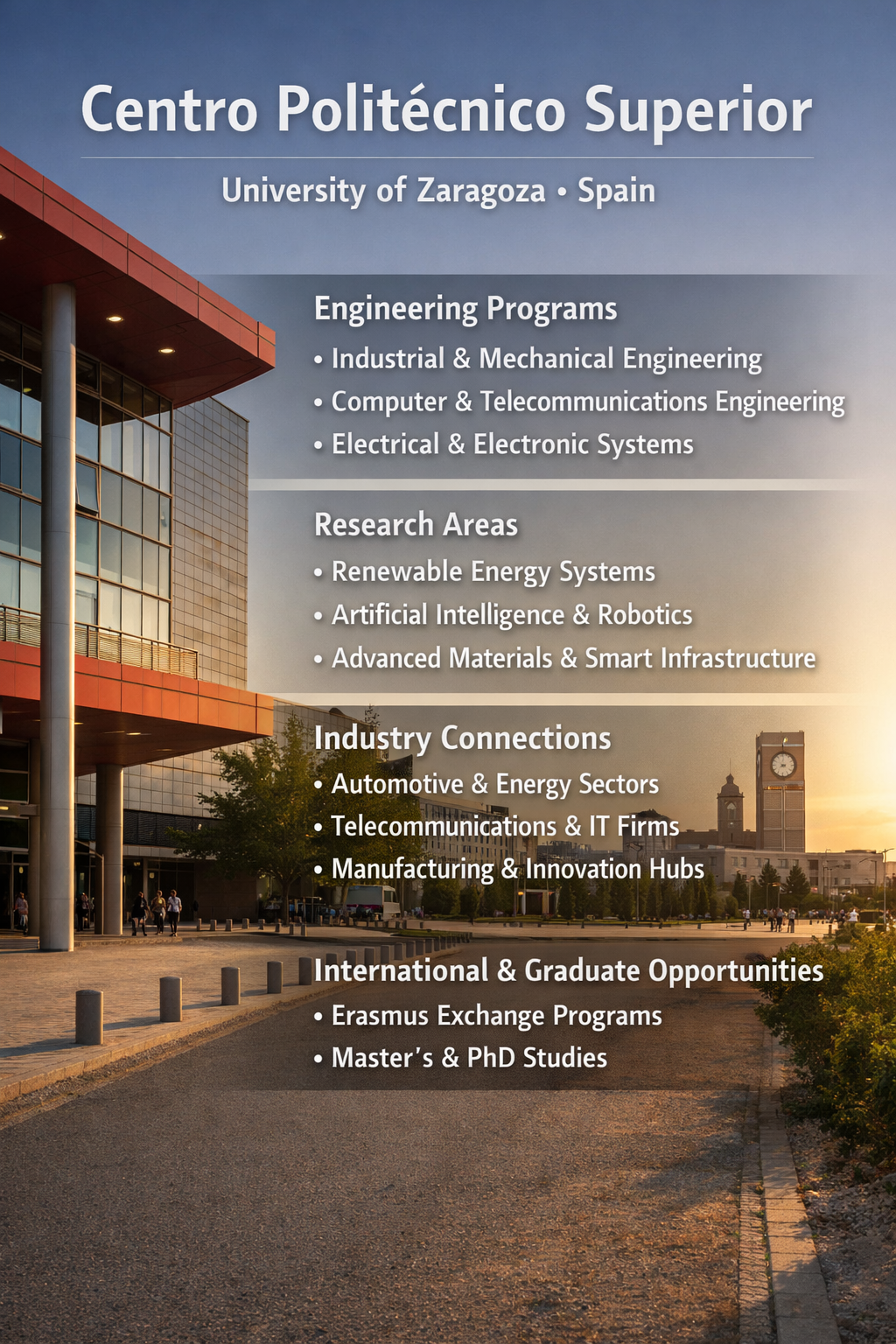
Higher education in engineering has evolved far beyond lecture halls and textbooks. Institutions today are expected to balance academic theory with industry relevance, research capability, and real-world problem solving. The Centro Politécnico Superior represents one such model — an academic environment shaped by technical rigor, interdisciplinary learning, and close alignment with modern engineering demands.
Located within Spain’s public university system, the center has developed a reputation for preparing engineers and technical professionals who understand not only how systems work, but why they matter in society.
Understanding the Role of Centro Politécnico Superior in Modern Engineering Education
Engineering schools often face a difficult challenge: maintaining academic depth while keeping pace with rapid technological change. The Centro Politécnico Superior addresses this through structured specialization combined with applied learning.
Rather than separating theory from practice, students typically encounter both simultaneously. A mechanical engineering concept, for example, may move quickly from mathematical modeling into laboratory experimentation or collaborative design projects.
This approach mirrors professional engineering environments, where solutions rarely exist in isolation.
The institution operates as part of the University of Zaragoza, one of Spain’s longstanding public universities known for technical and scientific education. Integration within a broader university framework allows engineering students to collaborate with departments such as physics, mathematics, architecture, and computer science.
That interdisciplinary exposure increasingly defines successful technical education.
Academic Structure at Centro Politécnico Superior
The academic organization follows the European Higher Education Area (EHEA) framework, meaning programs are structured into undergraduate, master’s, and doctoral pathways.
Undergraduate Engineering Programs
Students typically begin with foundational scientific training before progressing toward specialization. Core areas often include:
- Industrial Engineering
- Computer Engineering
- Telecommunications Engineering
- Mechanical Engineering
- Electrical and Electronic Systems
Early coursework emphasizes analytical thinking. Mathematics, physics, and programming form the backbone before students move into applied engineering systems.
A noticeable feature is the steady increase in project-based assignments as students advance. By later years, teamwork becomes central — reflecting how engineering projects function outside academia.
Master’s and Advanced Specialization
Graduate programs tend to focus on emerging technological domains such as:
- Automation and robotics
- Data systems and computing architectures
- Energy efficiency and sustainable engineering
- Intelligent manufacturing systems
These programs often attract both recent graduates and working professionals seeking technical advancement.
Unlike purely research-driven institutions, professional applicability remains a consistent priority.
Centro Politécnico Superior and Research Culture
Research activity plays a defining role in the institution’s identity. Engineering schools today are judged not only by teaching quality but by their contribution to innovation.
Research groups connected to the Centro Politécnico Superior commonly work in areas including:
- Renewable energy systems
- Artificial intelligence applications
- Advanced materials engineering
- Smart infrastructure
- Industrial automation
Many projects emerge through partnerships with regional industries. This collaboration allows students and researchers to work on practical challenges rather than theoretical exercises alone.
For example, energy optimization studies may directly support manufacturing facilities seeking reduced operational costs or environmental impact.
Such cooperation benefits both sides: companies gain technical insight, while students experience realistic engineering constraints.
Learning Environment and Campus Experience
Engineering education can sometimes feel abstract or overly technical. What distinguishes institutions like this one is how learning spaces are designed to reduce that gap.
Laboratories, simulation centers, and technical workshops serve as everyday academic environments rather than occasional resources.
Students frequently move between:
- Lecture sessions
- Laboratory experimentation
- Collaborative design studios
- Research facilities
The campus environment in Zaragoza also contributes to the academic experience. As an industrial and logistical hub in northeastern Spain, the city provides access to manufacturing companies, technology firms, and engineering consultancies.
This proximity helps bridge education and employment opportunities.
Industry Collaboration and Employability Outcomes
One practical question prospective students often ask is simple: Does this education translate into real employment?
Engineering schools increasingly measure success through graduate outcomes, and industry collaboration plays a key role here.
The Centro Politécnico Superior maintains relationships with companies involved in:
- Automotive engineering
- Energy production
- Telecommunications infrastructure
- Software development
- Industrial manufacturing
Internships and cooperative training placements allow students to apply academic knowledge before graduation.
Employers often value graduates who already understand workflow systems, deadlines, and interdisciplinary coordination — skills difficult to teach purely through lectures.
International Perspective and Academic Mobility
European engineering education encourages mobility, and students commonly participate in exchange programs across partner universities.
Exposure to international academic systems helps students adapt to different engineering standards and professional cultures.
For many participants, studying abroad becomes less about travel and more about learning how engineering challenges vary across regions — whether related to infrastructure design, environmental regulations, or technological priorities.
English-taught graduate programs have also expanded accessibility for international students seeking technical education in Spain.
Technology, Innovation, and Digital Transformation
Engineering institutions cannot remain static while technology evolves. Digital transformation has reshaped how technical education is delivered.
At the Centro Politécnico Superior, digital tools increasingly support learning through:
- Simulation software for engineering modeling
- Remote laboratory access
- Data analysis platforms
- Collaborative coding environments
Students learn not only traditional engineering principles but also how digital systems influence modern industry operations.
This shift reflects a broader reality: today’s engineer is as likely to analyze datasets as to design mechanical components.
Academic Challenges and Realistic Expectations
Engineering education anywhere in the world carries a demanding workload, and this institution is no exception.
Students frequently encounter:
- Intensive mathematical coursework
- Long laboratory sessions
- Group project coordination challenges
- Tight technical deadlines
Success often depends less on raw intelligence and more on consistency and problem-solving persistence.
Many graduates later note that the most valuable lesson learned was not a specific formula but the ability to approach complex problems methodically.
Contribution to Regional and Scientific Development
Technical universities often act as innovation engines within their regions.
Research initiatives connected to the Centro Politécnico Superior contribute to:
- Industrial modernization
- Sustainable energy adoption
- Smart city development
- Digital infrastructure improvement
Universities play a subtle but powerful role in economic ecosystems. Graduates enter local industries, research findings influence production methods, and startups emerge from academic experimentation.
Over time, these incremental contributions shape regional technological growth.
Who Typically Chooses Centro Politécnico Superior?
The institution attracts a diverse mix of students:
- Local Spanish engineering aspirants
- International STEM students
- Professionals pursuing advanced specialization
- Researchers interested in applied engineering fields
Students who thrive here often share a practical curiosity — an interest not just in understanding technology but in building or improving systems.
Engineering education tends to reward those comfortable with experimentation and iterative learning rather than immediate perfection.
FAQ: Centro Politécnico Superior
Is Centro Politécnico Superior part of a university?
Yes. It operates within the University of Zaragoza, meaning students benefit from broader academic resources while studying in a specialized engineering environment.
What language are programs taught in?
Most undergraduate programs are primarily in Spanish, though many master’s courses and research activities incorporate English instruction, especially for international collaboration.
Is it suitable for international engineering students?
It can be a strong option, particularly for students interested in European engineering standards and exchange opportunities. Language preparation may be necessary depending on the program.
How practical is the engineering training?
Programs generally combine theory with laboratory and project work. Industry placements and applied research help students gain practical exposure before graduation.
What career paths do graduates usually follow?
Graduates move into sectors such as manufacturing, IT systems, energy engineering, telecommunications, and research roles across Spain and the wider European market.
Engineering education succeeds when it connects knowledge with application. The Centro Politécnico Superior illustrates how technical institutions can evolve alongside industry needs while preserving academic rigor.
Its value lies less in prestige labels and more in steady, structured preparation — producing engineers capable of adapting to technological change rather than simply memorizing it
 ATIF
ATIF
[…] in names like Claude Edward Elkins Jr reflects a wider cultural […]
The focus on societal relevance is key! Engineering isn’t just about making things work; it’s about making things that matter. The Centro Politécnico Superior seems to be doing a great job of showing students the bigger picture.
It’s refreshing to see an institution like Centro Politécnico Superior prioritizing the integration of theory and practice—especially in a field where the gap between academia and industry can often feel overwhelming. The emphasis on interdisciplinary learning and real-world problem-solving really speaks to what engineering education needs to evolve toward. I’m curious how they manage to maintain such a balance while also keeping up with fast-paced technological changes.
It’s refreshing to see an institution like Centro Politécnico Superior prioritizing the integration of theory and practice—especially in a field where the gap between academia and industry can often feel overwhelming. The emphasis on interdisciplinary learning and real-world problem-solving really speaks to what engineering education needs to evolve toward. It would be interesting to hear more about how they measure the impact of this approach on student outcomes and industry readiness.