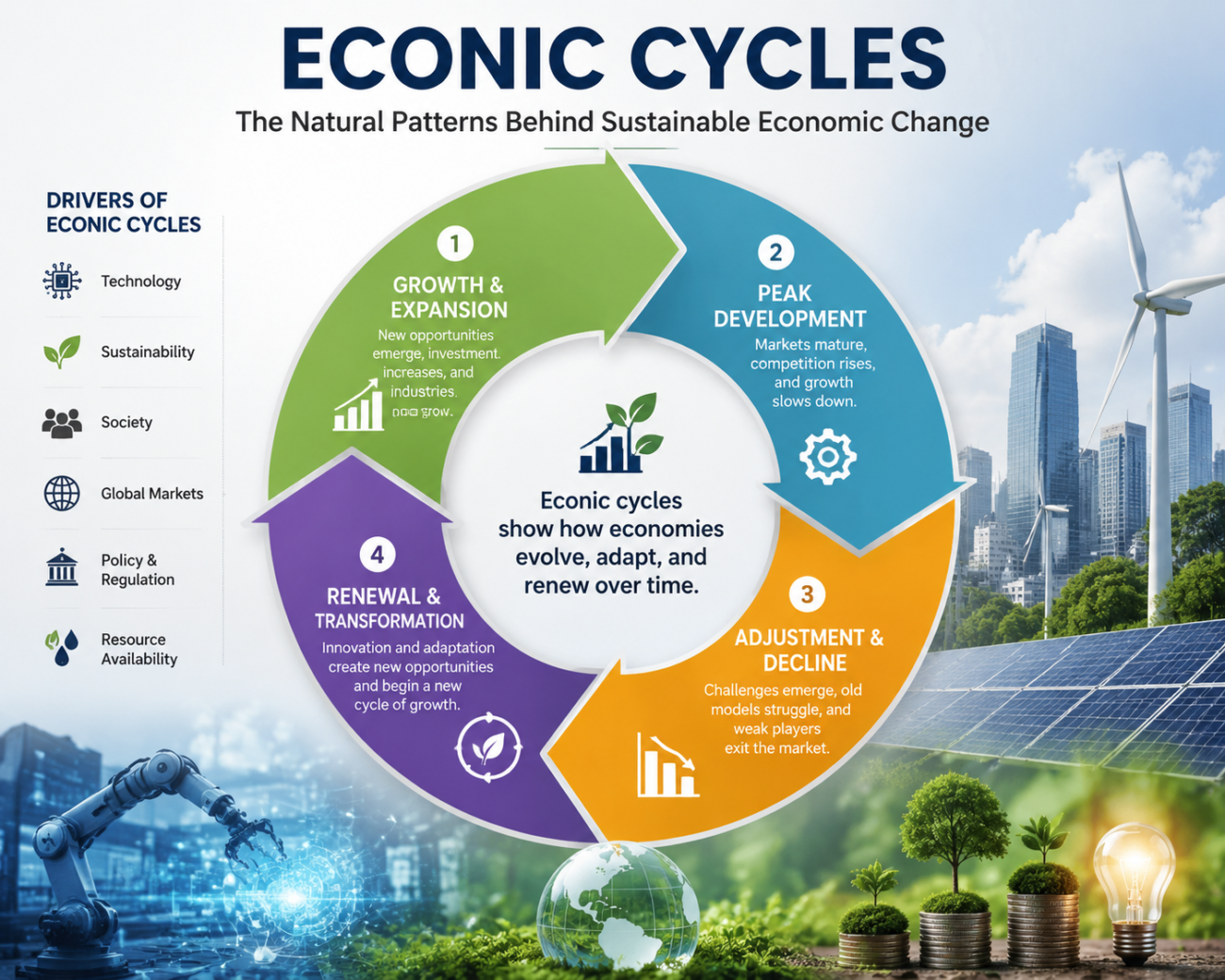
Econic cycles describe recurring patterns of change that influence how economies, businesses, technologies, and societies develop over time. While the term is not as widely used as traditional economic cycle concepts, it represents the idea that economic activity often moves through recognizable phases of growth, transformation, adjustment, and renewal.
Understanding econic cycles can help businesses, investors, policymakers, and individuals make better decisions. Markets rarely move in a straight line. They respond to innovation, consumer behavior, resource availability, environmental pressures, and broader social changes.
By studying these cycles, we can better understand why industries rise and fall, why certain technologies become dominant, and why periods of rapid growth are often followed by periods of correction.
What Are Econic Cycles?
Econic cycles refer to repeated patterns of economic and ecological change that affect the way resources, industries, and societies operate. The concept combines ideas from economics, sustainability, and long-term development.
Unlike short-term market fluctuations, econic cycles focus on broader transformations. They examine how economies adapt when conditions change, such as the introduction of new technologies, shifts in energy sources, changes in consumer demand, or environmental limitations.
For example, the transition from traditional manufacturing to digital industries represents a major economic cycle. Companies that adapted to automation, software, and online services grew rapidly, while businesses that failed to change often declined.
Econic cycles are not always predictable. They are influenced by many interconnected factors, making them complex rather than perfectly repetitive.
The Main Stages of Econic Cycles
Most econic cycles can be understood through several common stages. These stages show how industries and economies often evolve over time.
1. Growth and Expansion
The first stage begins when new opportunities emerge. This may happen because of technological innovation, increased demand, new resources, or changes in consumer preferences.
During this phase, businesses often experience strong growth. Investment increases, new companies enter the market, and competition encourages further development.
A modern example is the growth of renewable energy. As concerns about climate change increased, investment in solar power, electric vehicles, and energy storage expanded significantly.
2. Peak Development
After a period of rapid expansion, industries often reach a mature stage. Growth continues, but at a slower pace.
At this point, competition becomes stronger. Companies focus on efficiency, cost reduction, and improving existing products rather than creating entirely new markets.
The automobile industry provides an example. After decades of expansion, traditional car manufacturers reached a mature market where innovation shifted toward electric vehicles, autonomous driving, and cleaner technologies.
3. Adjustment and Decline
No economic system grows forever. Eventually, industries face challenges such as changing consumer behavior, resource limitations, increased competition, or technological disruption.
During this stage, weaker companies may leave the market while stronger organizations adapt.
The decline of physical media, such as DVDs, shows how economic cycles work. Streaming platforms changed entertainment consumption, forcing traditional media businesses to transform.
4. Renewal and Transformation
The final stage involves adaptation and the creation of new opportunities. Declining industries may evolve into new forms rather than disappear completely.
For example, traditional banking has changed significantly with digital banking, mobile payments, and financial technology platforms.
This renewal process creates the foundation for a new economic cycle.
How Econic Cycles Differ From Traditional Economic Cycles
Traditional economic cycles usually focus on periods of expansion and contraction in overall economic activity. These cycles often include phases such as recovery, growth, recession, and stabilization.
Econic cycles take a broader view. They consider not only financial performance but also technological progress, resource use, environmental conditions, and social behavior.
A traditional economic cycle may ask:
- Why did unemployment increase?
- Why did consumer spending decrease?
- Why did businesses reduce investment?
An econic cycle approach also asks:
- What long-term changes are reshaping industries?
- Are current resources sustainable?
- Which technologies will define the next phase of growth?
This broader perspective helps explain why some industries recover after disruption while others permanently change.
The Role of Technology in Econic Cycles
Technology is one of the strongest drivers of econic cycles. Major innovations often create entirely new industries while reducing demand for older ones.
The internet, smartphones, artificial intelligence, and renewable energy technologies have all influenced economic patterns.
When a new technology becomes affordable and widely adopted, it can create a wave of investment and business growth. Over time, the technology becomes normal, and attention shifts toward the next innovation.
Artificial intelligence is a current example. Businesses are exploring AI applications in healthcare, finance, manufacturing, and customer service. The long-term impact will depend on how effectively companies integrate these tools while managing challenges such as regulation, employment changes, and data security.
Econic Cycles and Sustainability
A major difference between modern economic thinking and older models is the growing importance of sustainability.
Traditional economic growth often focused mainly on production, consumption, and financial returns. Econic cycles include the relationship between economic activity and natural systems.
Resources such as energy, water, and raw materials influence how economies develop. When resources become limited or environmental costs increase, industries must adapt.
The shift toward circular economy models is one example. Instead of producing, using, and discarding products, companies are exploring recycling, repair, and reuse systems.
Businesses that recognize these changes early may find new opportunities, while those dependent on outdated models may struggle.
Examples of Econic Cycles in Different Industries
Energy Industry
The energy sector has experienced several major cycles. Coal and oil dominated industrial development for generations, but renewable energy is creating a new transformation.
Solar panels, wind power, battery storage, and smart grids represent a shift toward cleaner energy systems.
Technology Industry
Technology cycles move quickly. Personal computers changed workplaces, smartphones changed communication, and cloud computing changed how businesses operate.
Companies that adapt to these shifts often become market leaders.
Agriculture Industry
Agriculture has also experienced econic cycles. Traditional farming methods have gradually incorporated automation, biotechnology, precision farming, and data-driven decision-making.
The next phase may focus on improving efficiency while reducing environmental impact.
Why Understanding Econic Cycles Matters for Businesses
Businesses operate within larger economic and social systems. Understanding econic cycles helps organizations prepare for future changes instead of reacting after disruption occurs.
Companies that monitor trends can identify opportunities earlier. They can invest in new technologies, adjust their strategies, and develop products that match changing customer needs.
For example, companies that recognized the growth of online shopping before it became mainstream gained advantages over businesses that relied only on physical stores.
However, predicting cycles perfectly is difficult. External events, government policies, global conflicts, and unexpected innovations can change the direction of markets.
How Individuals Can Use Knowledge of Econic Cycles
Econic cycles are not only important for companies and investors. Individuals can also benefit from understanding long-term trends.
Career decisions, education choices, and personal investments are influenced by economic changes.
Learning skills connected to growing industries can improve future opportunities. At the same time, understanding economic transitions can help people prepare for periods of uncertainty.
The goal is not to predict every change but to recognize patterns and remain adaptable.
Challenges in Predicting Econic Cycles
Although cycles provide useful insights, they are not exact forecasts. Economic systems are influenced by human decisions, political events, technological breakthroughs, and unexpected challenges.
A new invention can accelerate change, while regulations or economic problems can slow it down.
Because of this, econic cycles should be viewed as a framework for understanding change rather than a strict timeline.
Successful decision-making requires combining long-term thinking with awareness of current conditions.
Frequently Asked Questions About Econic Cycles
What does econic cycle mean?
An econic cycle describes recurring patterns of change involving economic development, technology, resources, and social systems. It focuses on long-term transformation rather than short-term market movements.
Are econic cycles the same as business cycles?
No. Business cycles mainly focus on economic growth and decline, while econic cycles consider wider factors such as innovation, sustainability, and structural changes.
Can econic cycles be predicted accurately?
Not completely. They can help identify trends and possible future directions, but unexpected events can change how cycles develop.
Why are technology changes important in econic cycles?
Technology often creates new industries and changes existing ones. Major innovations can reshape markets, consumer behavior, and economic growth patterns.
How can businesses prepare for econic cycles?
Businesses can prepare by monitoring industry trends, investing in innovation, improving flexibility, and understanding changing customer needs.
Final Thoughts
Econic cycles provide a useful way to understand how economies and societies evolve over time. They show that growth, disruption, and renewal are connected parts of long-term development.
The businesses and individuals that adapt successfully are usually those that recognize change early and remain open to new opportunities.
While no cycle follows a perfect pattern, studying these movements helps create a clearer picture of how technology, resources, and economic decisions shape the future.
