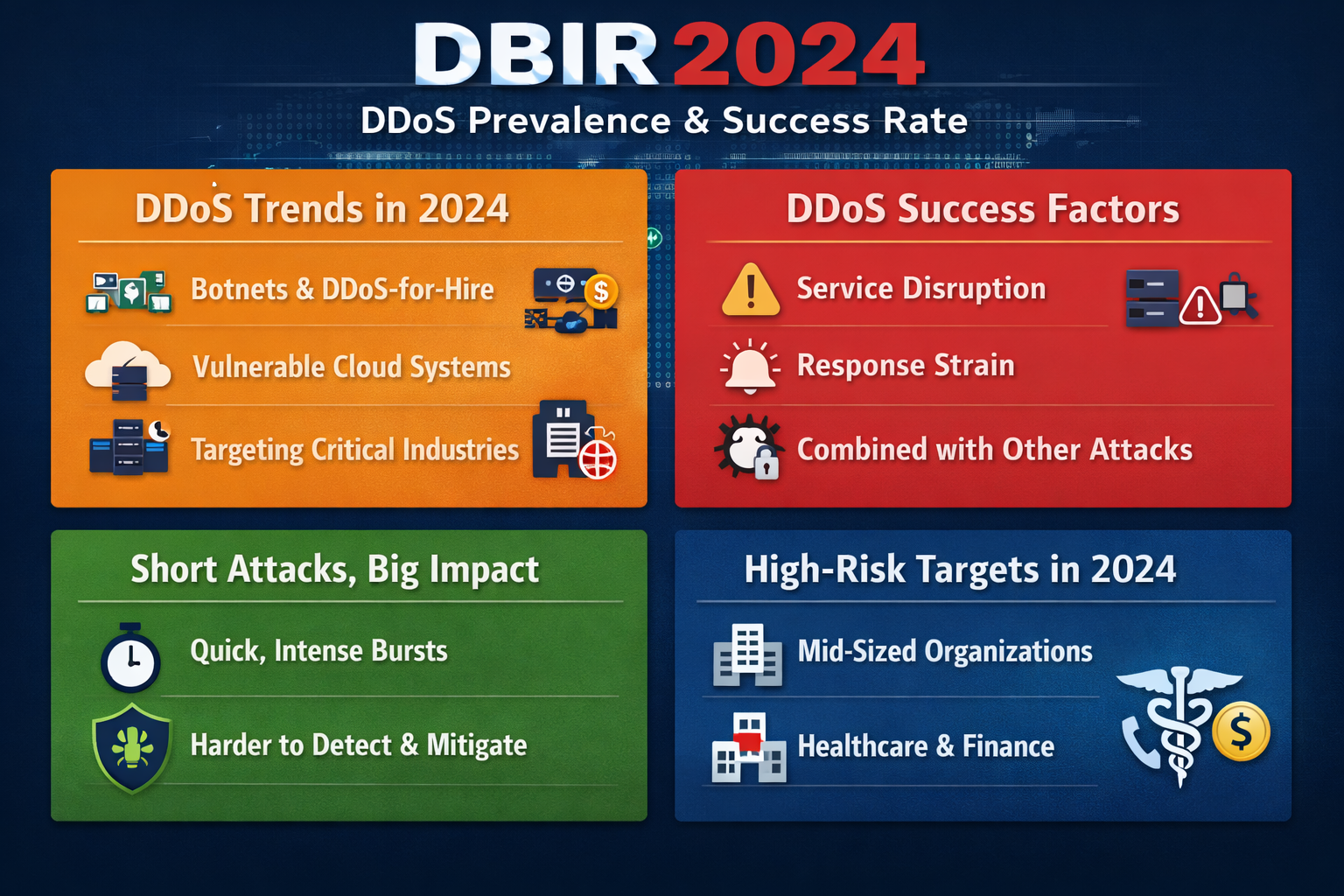
The DBIR 2024 DDoS prevalence success rate has become a point of real concern for security teams, hosting providers, and business owners who rely on online availability. The latest findings from the Verizon Data Breach Investigations Report 2024 don’t paint a dramatic, alarmist picture—but they do reveal a steady, measurable shift in how denial-of-service attacks are used and how often they succeed.
What stands out in 2024 isn’t just volume. It’s intent. DDoS attacks are being launched with clearer objectives, better timing, and a stronger understanding of how modern infrastructure actually breaks.
Understanding DDoS in the Context of DBIR 2024
Distributed Denial-of-Service attacks are not new. What has changed is their role. In earlier years, DDoS was often digital vandalism—noisy, blunt, and easy to spot. DBIR 2024 shows that DDoS is now frequently part of a broader strategy.
Attackers use DDoS to distract security teams, pressure organizations during extortion attempts, or test response capabilities before launching something more damaging. That context matters when we talk about prevalence and success rate.
In the report, DDoS is categorized less as a standalone event and more as a supporting tactic. This subtle reframing explains why success metrics are evolving.
DDoS Prevalence in DBIR 2024: A Steady Rise, Not a Spike
The DBIR 2024 data indicates that DDoS incidents continue to increase year over year, but not explosively. The growth is consistent rather than sudden, which suggests attackers are refining their approach rather than experimenting wildly.
Several factors contribute to this trend:
- Low-cost access to botnets and DDoS-for-hire services
- Misconfigured cloud and edge infrastructure
- Increased dependence on always-on digital services
The prevalence is especially noticeable in sectors where downtime translates directly to financial or reputational damage—technology, finance, healthcare, and online services.
Why Prevalence Doesn’t Always Mean Impact
One important nuance in the DBIR 2024 DDoS prevalence success rate is that not every attack aims to knock systems offline for hours. Many attacks are brief and targeted, designed to cause disruption rather than collapse.
A ten-minute outage during peak hours can be “successful” from an attacker’s perspective, even if systems recover quickly.
Measuring the DDoS Success Rate in DBIR 2024
Success rate is where interpretation becomes tricky. DBIR does not define success solely as “total outage.” Instead, success is often inferred from outcomes like service degradation, response strain, or secondary effects.
According to DBIR 2024 patterns, a significant portion of DDoS attacks achieve at least one of these goals:
- Temporary service slowdown or unavailability
- Increased operational cost due to mitigation
- Forcing security teams into reactive mode
From that lens, the DDoS success rate is higher than many organizations assume, even when defenses technically “work.”
Short Attacks, Real Consequences
One recurring insight from DBIR 2024 is the effectiveness of short-duration attacks. Attacks lasting under an hour are harder to analyze and easier to repeat.
These bursts often slip through thresholds designed for sustained traffic floods, making them disproportionately successful relative to their size.
Infrastructure Choices and Their Role in Success Rates
The DBIR 2024 DDoS prevalence success rate is closely tied to architectural decisions. Organizations with legacy on-prem systems or poorly configured cloud environments appear more vulnerable.
Modern mitigation tools help, but they are not automatic shields. Success often depends on:
- Proper traffic baselining
- Region-aware load balancing
- Clear escalation procedures
DBIR data implies that failures are less about missing tools and more about misalignment between tools and real-world traffic patterns.
Cloud Is Not a Free Pass
A common assumption is that cloud-hosted services are inherently DDoS-resistant. DBIR 2024 quietly challenges that idea.
Cloud platforms absorb scale well, but misconfigured autoscaling or exposed APIs can still become choke points. Attackers increasingly understand these nuances.
DDoS as a Companion to Other Attacks
Another reason the DBIR 2024 DDoS success rate matters is its relationship with other attack types. DDoS is frequently observed alongside credential attacks, ransomware, or data exfiltration attempts.
While defenders focus on restoring availability, attackers may probe authentication systems or exploit delayed alerts. In these cases, DDoS doesn’t need to “win” outright—it just needs to distract.
This pattern appears repeatedly in DBIR case analysis, even when DDoS is not the headline incident.
Who Is Most Affected According to DBIR 2024?
DBIR data suggests DDoS attacks are not evenly distributed. Smaller organizations experience fewer attacks, but higher relative impact. Larger organizations face more frequent attacks but recover faster.
Mid-sized organizations often fall into the most dangerous zone: visible enough to be targeted, but not always mature in response planning.
Industries with strict uptime expectations—such as payment services and healthcare—also see higher attacker persistence.
What “Success” Looks Like to Attackers in 2024
One of the clearest takeaways from DBIR 2024 is that attacker definitions of success have evolved.
Success may mean:
- Forcing an emergency maintenance window
- Triggering customer complaints
- Demonstrating capability during extortion
Measured this way, the DBIR 2024 DDoS prevalence success rate reflects strategic pressure rather than raw destruction.
Defensive Maturity and Its Limits
Organizations with mature DDoS playbooks fare better, but DBIR 2024 shows no one is immune. Even well-prepared teams experience partial failures.
The difference is recovery time and downstream damage. Mature teams isolate incidents. Less prepared teams let small disruptions cascade into broader issues.
That distinction matters more than absolute prevention.
Practical Lessons from DBIR 2024
The report doesn’t offer flashy recommendations, but the implications are clear:
- Monitor for short, irregular traffic spikes
- Treat DDoS alerts as potential precursors
- Align mitigation thresholds with business risk
DDoS defense is less about blocking everything and more about understanding what “normal” actually looks like for your systems.
Why the DBIR 2024 DDoS Data Feels Different
Compared to earlier editions, DBIR 2024 feels more grounded. There is less emphasis on extreme attack sizes and more focus on operational reality.
That shift makes the DDoS prevalence success rate more relevant. It reflects what actually disrupts businesses, not just what looks impressive on a chart.
FAQ: DBIR 2024 DDoS Prevalence Success Rate
How does DBIR 2024 define DDoS success?
Success is implied through outcomes like disruption, response strain, or secondary impact—not just full outages.
Is the DDoS success rate increasing according to DBIR 2024?
Yes, when success is measured by disruption rather than downtime, the effective success rate is higher than in past years.
Are DDoS attacks usually the main incident?
Often no. DBIR 2024 shows DDoS is frequently used as a supporting or distracting tactic.
Do cloud-based systems significantly reduce DDoS risk?
They reduce some risks, but misconfigurations still lead to successful attacks, according to DBIR patterns.
Which organizations should worry most about DDoS in 2024?
Mid-sized organizations and uptime-critical industries face the highest relative risk.
Can short DDoS attacks really be dangerous?
Yes. DBIR 2024 highlights short attacks as especially effective due to detection and response gaps.
Final Thought
When viewed carefully, the DBIR 2024 DDoS prevalence success rate is less about fear and more about clarity. The data shows attackers exploiting operational gray areas—not technological ignorance. For organizations willing to study their own traffic patterns and response assumptions, that insight is more useful than any headline statistic.
